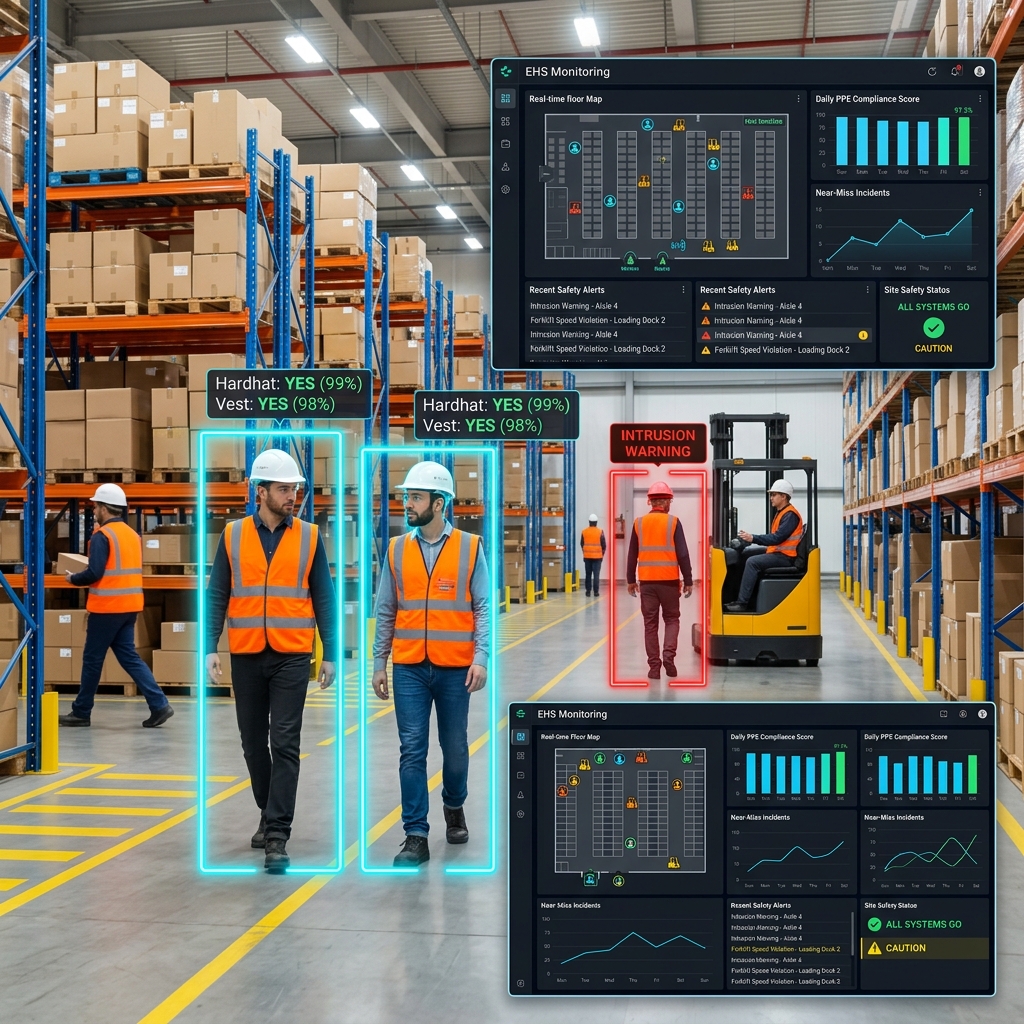
Enforcing Hardhat & Safety Vest Compliance with Visual AI
Industrial environments such as distribution centers, loading docks, and manufacturing plants present constant safety hazards. According to national workplace safety bodies, falls and vehicle collisions are the leading causes of warehouse injuries. While Personal Protective Equipment (PPE)—including hardhats, high-visibility safety vests, and steel-toed boots—significantly mitigates these risks, manual compliance auditing is highly ineffective.
EHS (Environment, Health, and Safety) managers cannot monitor every warehouse aisle continuously. By overlaying deep-learning object-detection systems onto existing IP security cameras, the CloudZigs Warehouse AI Platform automates safety auditing, active risk detection, and safety violation logging 24/7.
"True safety automation is not about auditing violations after an accident; it is about real-time warnings that prevent the accident from occurring."
1. Real-time PPE Omission Alerts
The CloudZigs platform deploys highly optimized convolutional neural networks (CNNs) trained on safety vest reflective materials and hardhat profiles. The moment an employee or contractor enters an active machinery corridor without wearing a hardhat or high-vis vest, the system detects the omission and dispatches a notification to the zone supervisor, along with an image snippet for documentation. Compliance rates typically improve to over 98% within the first month of deployment.
2. Forklift & Pedestrian Zone Intrusion
Forklift corridors and pedestrian lanes must remain strictly separated. The visual AI platform defines dynamic digital boundaries (virtual zones) around operating forklifts. If a pedestrian walks into a forklift zone, or if a forklift operates outside its designated corridor, the system triggers local flashing sirens and updates the operator's dashboard to prevent immediate collision hazards.
3. Automated Compliance Analytics
Manual safety tracking is often based on sporadic audits. The Warehouse AI system generates continuous historical safety analytics, identifying which areas of the warehouse have the lowest compliance rates or highest near-miss violations. This allows EHS teams to run targeted training seminars and re-design facility layout markings to address root-cause safety risks.






Anil Deshmukh Reply
Automating our EHS compliance reports has saved our team hours of manual logbooks. We now have a dashboard showing safety metrics across all three shifts. It has dramatically improved safety culture.