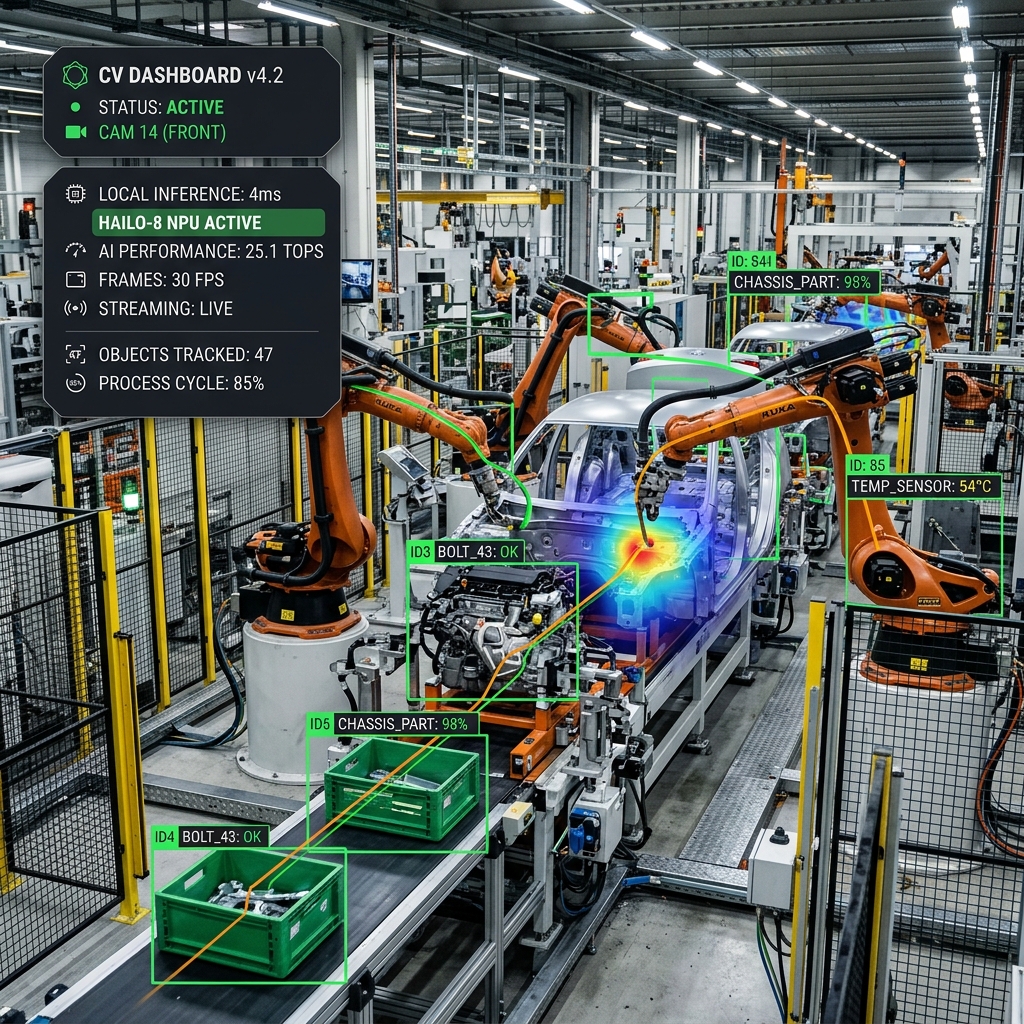
Why Local Edge AI Accelerators Trump Cloud Computing for Factories
Modern factories and logistics centers are increasingly adopting AI-driven automation. However, system architects face a critical architectural decision: Should visual processing be executed on centralized cloud servers, or is it better to run neural networks locally on hardware at the facility level?
While cloud computing offers elastic scaling and massive storage capacities, it suffers from several major limitations when applied to real-time industrial operations. Local Edge AI accelerators, such as the CloudZigs Edge Box (powered by dedicated NPUs like NVIDIA Jetson or Hailo-8), process camera feeds on the factory floor itself, proving far superior across three critical pillars: latency, bandwidth cost, and data security.
"In industrial safety and assembly lines, a 100ms delay in alert dispatch is the difference between a near-miss and a severe workplace injury."
1. The Latency Gap: Under 10ms vs. 200ms+
For applications like forklift collision prevention or automated machine shutdown during mechanical failures, speed is paramount. Streaming video data to a cloud server, running model inference, and returning alert commands introduces networking latency that often exceeds 200ms—even on high-speed lines. By running model inference on-premise, Edge AI units deliver alerts within 10ms, enabling instant relays to safety sirens or machine controllers.
2. bandwith and Data Egress Constraints
A medium-sized facility with 30 high-definition IP cameras generates immense amounts of video data. Streaming thirty 1080p feeds 24/7 requires around 120 Mbps of dedicated upstream bandwidth. In rural industrial zones, maintaining this level of connectivity is expensive and highly unreliable. If connection drops, cloud-based monitoring fails completely. Local Edge AI processes the video streams offline, requiring internet access only to send compact JSON metadata alerts or periodic reports.
3. Data Sovereignty and Compliance
Factories often work with confidential manufacturing processes, proprietary assembly layouts, or strict privacy regulations regarding worker biometric data. Uploading raw videos to public cloud databases introduces significant security risks. With local Edge Box deployments, all raw frames are processed in volatile memory locally and discarded immediately, ensuring zero leak vectors and complete compliance with local data protection rules.





Rohan Das Reply
Completely agree on the bandwidth point. We run an automated brick factory in rural Rajasthan where broadband is highly unstable. Edge AI is the only way we could realistically implement safety zone monitoring.