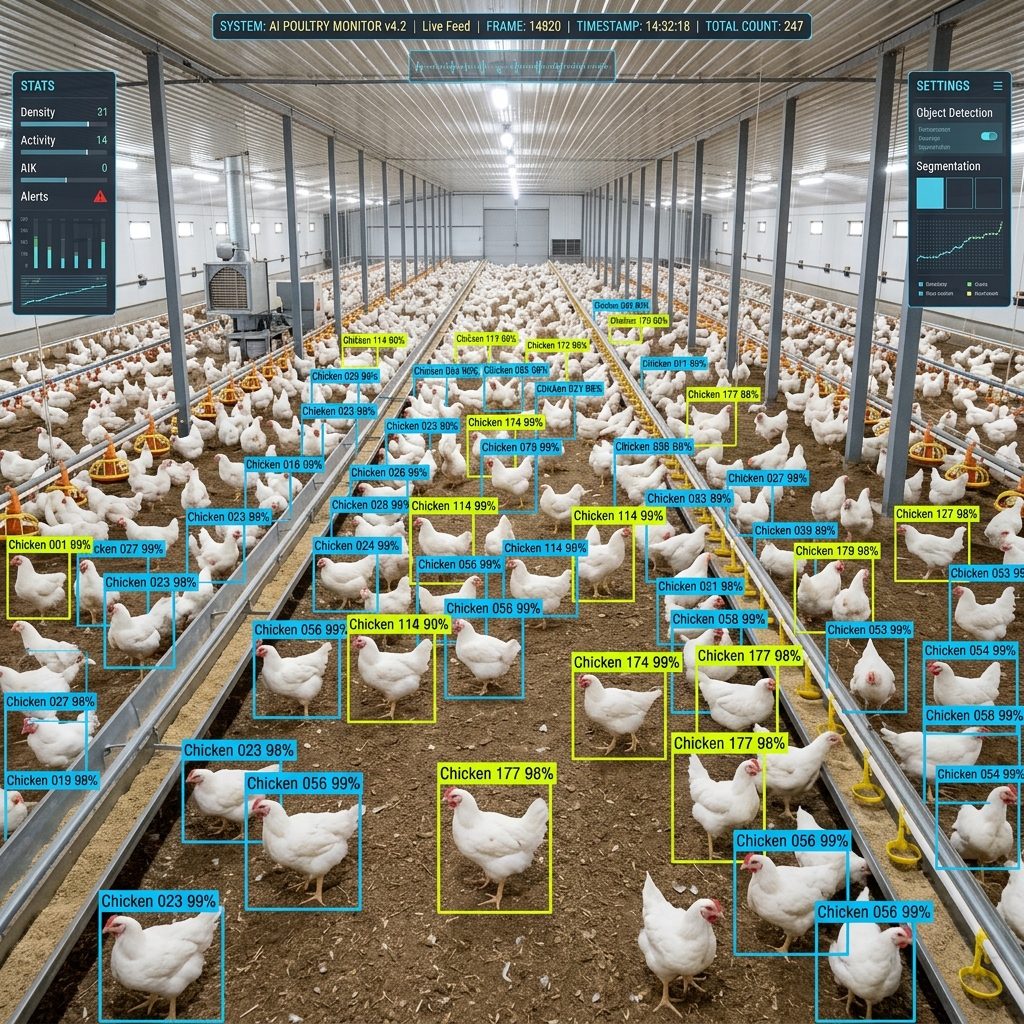
Automating Poultry Farms: The Role of Computer Vision in Smart Agriculture
Managing large-scale poultry sheds is historically a labor-intensive and hazardous task. In typical layer or broiler operations, workers must walk through the sheds multiple times daily to identify sick or dead birds, manually count eggs, check feeder blockages, and estimate flock weight. These manual sweeps not only fail to catch issues in real-time but also pose high biosecurity risks by introducing external pathogens into the poultry houses.
Computer Vision is transforming poultry management into a highly automated, data-driven operation. By utilizing overhead camera networks combined with local Edge AI analytics, poultry farm operators gain 24/7 visibility into flock behavior, health status, and productivity. Detections are executed locally within milliseconds, sending instant alerts to farm managers.
"Automating farm management through visual intelligence is the most effective way to eliminate biosecurity hazards while optimizing the feed conversion ratio (FCR)."
1. Automated Dead Bird Detection
Flock mortality is a critical metric. A single deceased bird left in a shed can quickly spread infectious diseases (such as Newcastle disease or avian influenza) to the rest of the flock. CloudZigs Poultry AI uses custom object-detection models that monitor the floor in real-time. By distinguishing between actively moving, resting, and dead birds, the system detects carcasses and sends immediate notifications with coordinate data, allowing workers to quickly isolate the location and remove the threat.
2. Automated Egg Counting
On conveyor belts and nest boxes, manual counting is prone to human error, resulting in inaccurate production reports. AI-driven vision sensors count eggs dynamically as they move along the collection line, achieving over 99.5% accuracy. Drops in daily egg yields are immediately flagged per row, allowing veterinarians to diagnose potential nutritional deficiencies or disease outbreaks early.
3. Continuous Weight & Behavior Diagnostics
Traditional weight auditing requires manual catching and weighing of birds, which stresses the animals and delays growth. Visual AI estimates average bird weight by capturing contours from overhead perspectives. Furthermore, flock clustering patterns are monitored: high-density clustering indicates drafts or cold zones, while scattering around drinking lines indicates heat stress or water line failures.






Karthik Raja Reply
We integrated the dead bird detection system on our broiler farm last month. It has significantly reduced the time our workers spend inside the sheds. The biosecurity benefit alone makes this investment worthwhile.